Hentley Farm
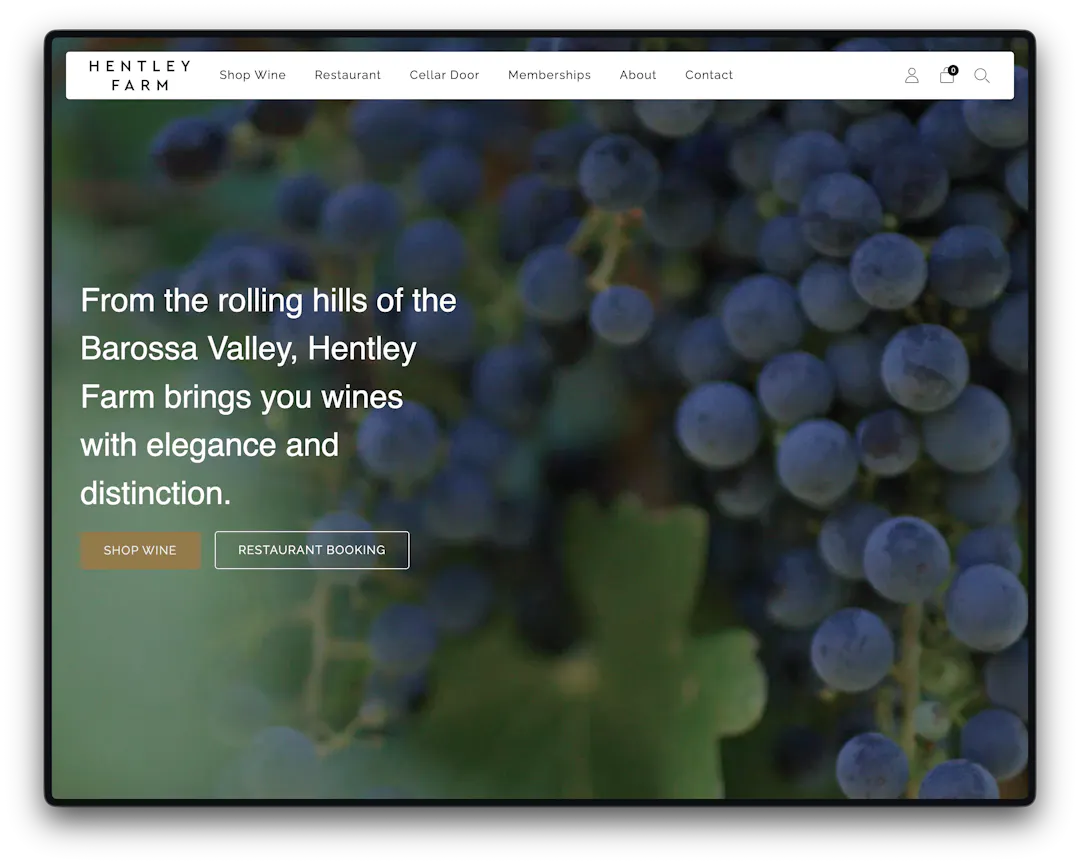
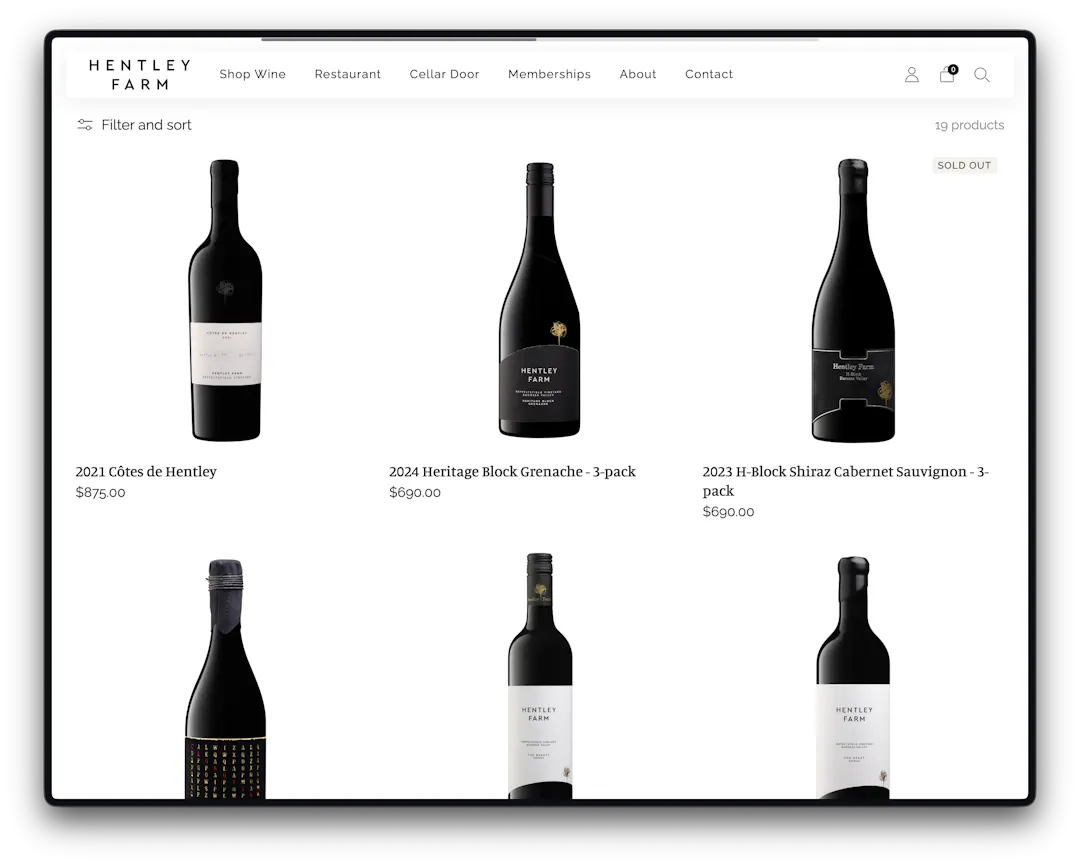
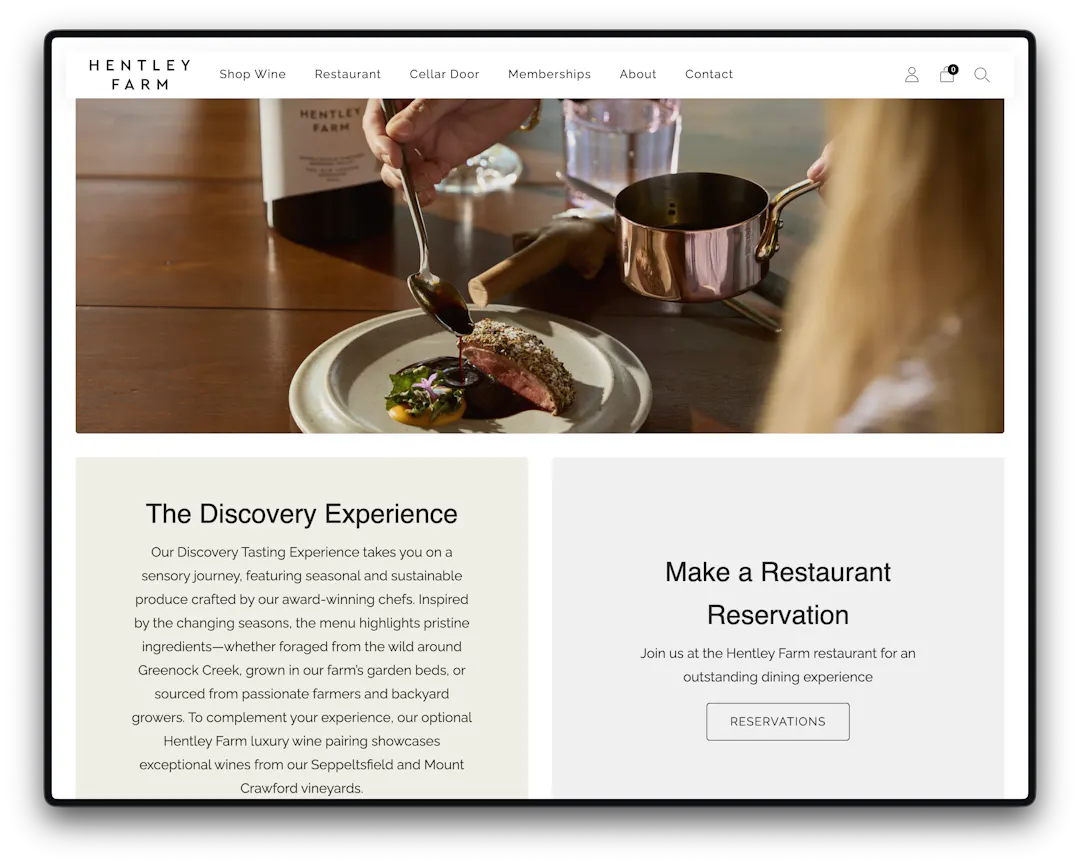
Not every brand needs headless — that's the common sense part. Hentley Farm had a spreadsheet of features quoted at $300k+ as custom development on Whppt, an agency-owned CMS. The right stack was a Shopify theme tailored hard: eight years of order history migrated, point of sale at the cellar door, Lightspeed on the restaurant floor, Wrapped, Klaviyo and Flow doing the rest.
 1 / 3
1 / 3- CLIENT
- HENTLEY FARM
- LIVE SINCE
- SEPTEMBER 2024 — AND STILL RUNNING
- MIGRATED FROM
- WHPPT — AN AGENCY-OWNED CMS, NO LONGER SUPPORTED
- THE ALTERNATIVE
- $300K+ QUOTED TO BUILD THE SPREADSHEET AS CUSTOM DEV
- STACK
- SHOPIFY · LIGHTSPEED · WRAPPED · KLAVIYO · FLOW · XERO · UNLEASHED
- SCOPE
- REPLATFORM + RETAIL OPERATIONS
This didn't start as a replatform. Hentley Farm came to the meeting with a spreadsheet — a long list of things they wanted the business to be able to do, gift cards among them. Quoted as custom development on the platform they already had, that list came to upwards of $300,000, on top of everything already spent building the platform it would sit on.
The site ran on Whppt, a content management system their previous agency built and owned. Other sites ran on it too — but Hentley Farm's was the only shop. The agency had extended Whppt for ecommerce and built them a back office to run orders, products and shipping, with custom integrations into Xero and Unleashed. All of it bespoke, all of it theirs alone.
Which is a fine arrangement until something breaks. Every new feature came back as a quote. So did every fix, because when you're the only shop on a platform you are also the only one who finds the bug, and the people who wrote it are the only ones who can mend it. They charge by the hour.
We met Stu about that spreadsheet. The argument was short. Hentley Farm is a singular winery, but operationally it wants what every other retailer wants: gift cards, loyalty, point of sale, email, the books talking to the stock. None of that needed inventing. It needed subscribing to. On Shopify and its app ecosystem the same features arrive as software subscriptions, and the vendors carry the support and the bug fixing on their own platforms, because they're already doing it for everyone else.
Hentley Farm got the spreadsheet. Every item on it. And the line in their budget for support and new feature development stopped being a line.
The argument
A Barossa winery shouldn't be the only customer of its own checkout.
Every ecommerce bug on Whppt was theirs to find and theirs to fund. On Shopify, a few million merchants hit it first.
Whppt is no longer supported. Hentley Farm had already left.
The stack, and why
| We chose | Over | Because |
|---|---|---|
| Shopify and its app ecosystem | $300k+ of custom development on Whppt | The features they wanted — gift cards, loyalty, POS, email — needed subscribing to, not inventing. On a custom build Hentley Farm paid every time it broke. Whppt is no longer supported; Shopify is too big to flake. |
| Shopify's Xero and Unleashed integrations | The custom ones Whppt needed | Shopify already talks to both. Plumbing that had been bespoke, quoted and maintained by the hour was connected in a day. |
| A Shopify theme, tailored hard | Headless | At the time it was the call that made sense. The work was in the back office — orders, POS, gift cards, automations — not in the storefront. |
| Lightspeed | Shopify POS | A restaurant floor needs restaurant features and Shopify POS doesn't have them. Pretending otherwise would have been us selling a stack instead of fitting one. |
| Shopify POS | Lightspeed | The cellar door sells bottles of wine and nothing else. That's the job Shopify POS already does. |
| Wrapped | Separate gift cards per system | One balance across the online store, the cellar door and the restaurant. It's the piece that stops two platforms feeling like two businesses. |
| Shopify Flow | Marsello | Their loyalty runs tiered discounts with qualifying conditions — order a certain number of bottles, then the discount applies. Marsello couldn't hold that. Flow can, and Hentley Farm hold the rules. |
The part everyone skips
Most replatforms fail before a line of code is written. They fail in the spreadsheet where somebody decided the order history was too hard to bring along.
Your history is the asset. Reviews, order counts, customer lifetime value — the things that make returning customers convert at three times the rate of cold traffic.
- URL maps before designs — rankings are revenue
- Redirects rehearsed on staging, twice
- Eight years of orders migrated and reconciled to the cent
- Xero and Unleashed reconnected in a day, off the shelf, where they had been custom
The cellar door kept trading
The site went live in September 2024. POS went live between tastings on a Tuesday. Klaviyo flows picked up the email busywork, Shopify Flow picked up the rest, and the team got documentation they actually read.
The restaurant runs Lightspeed — on purpose
Shopify POS could have run the restaurant. It earned the online store and the cellar door on merit — but a working restaurant floor is a different job, and Lightspeed does that job better. Hentley Farm runs Shopify for the online store and cellar door, and Lightspeed for the restaurant — one solution, each platform chosen on merit. We are platform agnostic: we don't sell a stack, we fit one.
Who did the work
- JasonCommon Sense — the pitch, the build, the integrations, the testing, and Jess's training
- Jess JennerHentley Farm — content, and the person Jason trained on the theme
The person who pitched it is the person who built it. And the person who'd be living in it every day was in the room from the start.
No account manager, no coordinator, nobody between Hentley Farm and the person writing the code. Jason trained Jess on the theme during the build rather than after it, which is the reason content changes stopped coming back to us.
Gift cards that work in all three places
Wrapped runs the gift cards, plugged into Shopify and Lightspeed both. Buy one online, spend it at the cellar door or in the restaurant. Two platforms, one balance — which is the only reason a customer never has to know there are two platforms. Gift cards were near the top of the spreadsheet. Here they're an app.
The loyalty programme we built twice
We integrated Marsello for loyalty first. In testing it couldn't hold Hentley Farm's actual rules — their tiers carry qualifying conditions, where you order a certain number of bottles before the discount applies. So we pulled it back out and rebuilt the lot in Shopify Flow. That cost us the integration work. It also means the rules now live in Hentley Farm's own admin, and they change them without asking us.
The rest of the spreadsheet turned out to be apps
Report Pundit does the reporting. Regios Automatic Discounts applies the discount rules. The rest of the office side runs the same way — smoothly enough that nobody talks about it, which is the point. Every one of those would have been custom development on the old platform: quoted, built, then maintained by the hour forever. Now they're subscriptions somebody else supports, and anything that stops earning its place gets switched off.
What Hentley Farm own now
- The loyalty rules — tiers and qualifying conditions, edited in their own Shopify admin
- The theme, and the training to change it — taught during the build, not handed over as a PDF after it
- A maintenance block they draw down from. No retainer, no minimum, no lock-in.
Leave whenever. Nobody ever does — but the door isn't locked.
The loyalty programme is the test. When the rules change, Hentley Farm change them — we don't get a ticket and they don't get an invoice.
The zero-orders-lost guarantee
Hentley Farm isn't covered by it. Hentley Farm is why it exists.
Eight years of order history moved with nothing lost. That's the job that made us willing to put it in writing for everyone after them: if a single order goes missing in your migration, the migration is free.
“They moved eight years of our history without losing a single order. The site got faster, the cellar door got simpler, and nobody held us hostage.”
- ENGAGEMENT
- 2024 — CURRENT
- THE SPREADSHEET
- EVERY ITEM ON IT, SHIPPED
- NEW FEATURES
- A SUBSCRIPTION, NOT A QUOTE
- SINCE LAUNCH
- 0 REBUILDS. 0 REPLATFORMS.
- PLATFORM UPGRADES
- SHOPIFY'S JOB, NOT THEIRS AND NOT OURS
- HOW SUPPORT RUNS
- A MAINTENANCE BLOCK THEY DRAW DOWN FROM
What people ask before they sign
Our platform was built specifically for us. Isn't that better than something off the shelf?
Shopify's entire company exists to do this one thing, and everything it builds arrives in your store the day it ships — the next generation of checkout, payments and fraud handling, without you asking for it or paying for it. Between the API and the App Store, about 99% of what a retailer actually needs is already there. The last 1% is the part worth paying someone for, and there's an order to it: a Shopify Flow first, then a private app, then custom code, because each step up costs more to own forever.
Hentley Farm's platform was built specifically for them. They were the only shop on it, so they found every bug and funded every fix, and it's no longer supported.
What happens to eight years of order history?
It comes with you. The history is the asset — reviews, order counts, lifetime value, the things that make a returning customer convert at several times the rate of a cold one. URL maps get written before anyone touches a design, redirects are rehearsed on staging twice, and the orders are migrated and reconciled to the cent before DNS moves.
Hentley Farm moved eight years and lost nothing. We now put that in writing: if a single order goes missing in your migration, the migration is free.
How long is our shop shut while you move it?
It isn't. The build runs on staging while the old site keeps trading, so the only moment that matters is the DNS cut, and that gets scheduled for the quietest hour in your week. Hentley Farm's point of sale went live between tastings on a Tuesday and the cellar door served straight through it.
Can our team change the site without coming back to you?
Yes, and it's built that way on purpose. The training happens during the build rather than as a handover document after it — Jess at Hentley Farm learned the theme while it was being made, which is why content changes stopped coming back to us at launch.
It goes deeper than pages, too. Their loyalty tiers and the qualifying conditions behind them are rules in their own admin, so when the offer changes, they change it. We're there for the things that genuinely need us.
What happens when we want a new feature?
We consult before we build. Most of the time the feature already exists, so the work is finding the app that does it, checking it against how you actually operate, and configuring it properly. When nothing fits, we propose something that does — Flow, private app, or code, in that order. What you don't get is a quote for bespoke development every time someone has an idea.
Hentley Farm's loyalty programme is the exception that proves the rule: Marsello couldn't hold their rules, so we rebuilt it in Flow and handed them the conditions to edit themselves.
Eight years moved, zero orders lost — and we now put that in writing. If a single order goes missing in your migration, the migration is free.